Birdwatching areas - Sangihe and Talaud islands, Indonesia: 1 by Jim C. Wardill and Jon Riley, from OBC Bulletin 29, May 1999. The remote Sangihe and Talaud islands are situated in the Celebes Sea between Sulawesi and the Philippine island of Mindanao. At the northern limit of the fascinating Wallacean biogeographical region, the islands are home to nine endemic species, five of which are endangered. Sangihe has little natural forest left and there are two key sites: Talawid in the north of the island is a good area for parrots, whilst Gunung Sahengbalira in the south is the only extensive area of forest left on Sangihe and has populations of four endangered endemic species, including two found only at this site. Talaud is a less developed and more remote archipelago. The largest island, Karakelang, has extensive areas of protected forest, supporting important populations of parrots. The islands can be visited year round, but the most productive time is during the drier months between April and September; the wet season from September to March can make the steep terrain very challenging. Below we give access and accommodation details for the island's key sites, along with notes on the more interesting species.
Access and accommodation
The islands are accessible from Manado, the provincial capital of North Sulawesi, which is served by international Silk Air flights from Singapore. In early 1999, flights to Sangihe and Talaud had fallen victim to the country's economic crisis and it was only possible to reach the islands by boat.
From Sulawesi
Ferries depart from Manado harbour at 6 p.m. every Monday, Wednesday and Friday evening for the 12 h crossing to Tahuna, Sangihe. Ferries to Beo, Karakelang, Talaud and Lirung depart from Manado every Tuesday and Thursday evening at 6 p.m. The Pulo Teratai and the Valentine travel direct, the journey to Beo taking approximately 20 h; the Agape Star travels via Tamako and Tahuna, adding six hours to the journey time. Return ferries from Tahuna, Sangihe, are on Tuesday, Thursday and Saturday evening at 6 p.m.; from Talaud on Wednesday and Friday afternoons. It is advisable to buy tickets at the harbour in the morning to ensure a place to sleep on these crowded boats. The KM Tilongkabila, which has luxury cabins, sails through the islands once every 28 days. It leaves Bitung, North Sulawesi, sails directly to Talaud and then returns to Bitung via Tahuna, before heading on to Gorontalo. Schedules and tickets are available from PELNI: Jl. Sam Ratulangi 7, Manado (telephone 0431-862844).
Sangihe
The infrastructure on Sangihe is well developed with good roads, hotels and international telephone links. Tahuna, the capital, is the transport hub and buses to all towns on the island can be found at the new bus station on Jalan Makaampo; one can also charter mikrolets (blue minibuses) to anywhere on the island for approximately US$10. In Tahuna stay at the Hotel Nasional, Jalan Makaampo, (telephone 0432-21185/21462). There are many places to eat, the best probably the Marina Coffee House next door to Hotel Nasional. Food and supplies are available in Tahuna for trips to Talawid and Gunung Sahengbalira. Perhaps the star bird on Sangihe is the Cerulean Paradise-flycatcher Eutrichomyias rowleyi that was recently rediscovered by the Action Sampiri team. People wishing to search for this species should first contact the local office of Action Sampiri which will be opening soon.
Gunung Sahengbalira
The easiest way to get to this site is from Tamako (regular bus from Tahuna, a two-hour journey). Accommodation is available at the Rainbow Losmen in Lilipan B village which can be reached by minibus from Tamako; ask for Frets Pangimangen. Rooms with breakfast cost c. US$3 single or c. US$5 double, with full board for c. US$3 extra per person per day. Frets knows how to reach the forest on Sahengbalira and will organise guides or porters for you. Narrow trails lead into the forest and a path runs along most of the top of the ridge. The area of forest remaining on Gunung Sahengbalira is probably no more than 400 ha and to reach it is a two-hour climb. |
|
Cerulean
Paradise Flycatcher
(Jon Riley) |
Birds
Most species occur in the plantations surrounding the forest and it is certainly worthwhile birding them, particularly for skulking, understorey birds like the uncommon Red-bellied Pitta Pitta erythrogaster and Hooded Pitta P. sordida which is heard and seen regularly, and the occasional Lilac-marked Kingfisher Cittura cyanotis. Common species in the area include Black-naped Fruit Dove Ptilinopus melanospila, Blue-tailed Imperial Pigeon Ducula concinna, Slender-billed Cuckoo Dove Macropygia amboinensis and Black-naped Oriole Oriolus chinensis. Sometimes mixed-species flocks can be seen, usually comprising Yellow-sided Flowerpecker Dicaeum aureolimbatum, Grey-sided Flowerpecker D. celebicum, Brown-throated Sunbird Anthreptes malacensis and Black Sunbird Nectarinia aspasia. Overhead can be seen Moluccan Swiftlet Collocalia infuscata, Glossy Swiftlet C. esculenta and migrant White-throated Needletail Hirundapus caudacutus.  |
Lilac-marked
Kingfisher
(Jim Wardill) |
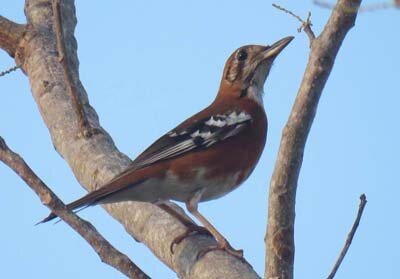
The endangered endemic Sangihe Hanging Parrot Loriculus catamene (local names: lungsihe/kurehi) is seen regularly, usually in small groups flying fast overhead. Listen for the high-pitched tseee tseee flight call. The newly described endemic Sangihe Scops Owl Otus collari (local name: burung hantu) is also relatively common in both plantations and forest, and is best located by listening for its down-slurred whistle in the hours after dusk. Possibly the commonest species in forest is the beautiful Elegant Sunbird Aethopyga duyvenbodei (local name: salumisi bamburaeng) which can be seen at all altitudes. There are occasional sightings in the forest, but the easiest place to see the sunbird is in old, scrubby plantations close to the forest edge.The recently rediscovered endemic Sangihe Shrike-thrush Colluricincla sanghirensis (local name: sohabe chocklat) is only known from sub-montane forest above c. 700 m on the Gunung Sahengbalira ridge. It is not uncommon and has been seen in quite large flocks, but can be surprisingly elusive. Birds are active throughout the day and a good strategy is to follow the ridge-top path and listen for their distinctive chweeep chweeep calls, not unlike young chickens. In addition to the endemic species there are a number of very distinct and rare subspecies confined to the mountain. The Sangihe race of Golden Bulbul Alphoixos affinis appears to be restricted to the ridge forest where it is often very vocal. Other specialities, known only from specimens and a few sight records, include the endemic subspecies of Sulawesi Dwarf Kingfisher Ceyx fallax sangirensis and the well-marked subspecies of Black-crowned White-eye Zosterops atrifrons nehrkorni. These birds can be very difficult to see and, again, much patience is required.
Talawid
Birding is in plantations and forest patches around the villages of Talawid and Talawid Atas, northern Sangihe. Talawid is reached by bus to Kendahe and accommodation is with Ali and Hety at the school in Talawid Atas; pay approximately US$6 a night and bring your own food. Ali will guide you to the best sites, including a Great-billed Parrot Tanygnathus megalorynchos roost; pay US$6 per day.
Birds
Although lacking the true forest specialists of Gunung Sahengbalira, many commoner species can be seen more easily at Talawid, together with others absent from the south. Raptors are well represented with Brahminy Kite Haliastur indus common, White-bellied Sea Eagle Haliaeetus leucogaster rare, Chinese Goshawk Accipiter soloensis common whilst on migration between October and March, and Peregrine Falcon Falco peregrinus rare and only at higher altitudes. In the undergrowth both pitta species are quite common, but Hooded Pitta is especially easy to see, as is Lilac-marked Kingfisher. The main reason to visit Talawid is to search for the rare Red-and-blue Lory Eos histrio (local name: sumpihi). This beautiful parrot is endemic to Sangihe and Talaud, but the population of the nominate Sangihe race is extremely small, and lories have only been seen at Talawid; birds were recorded in 1995, but absent from the site in 1996, and should be looked for in both forest patches and in plantations. Small remnant forest patches attract many pigeons and parrots to Talawid. In addition to species listed for Gunung Sahengbalira Grey-cheeked Green Pigeon Treron griseicauda, Pink-necked Green Pigeon T. vernans, Pied Imperial Pigeon Ducula bicolor and Spotted Dove Streptopelia chinensis are all very common, whilst Emerald Dove Chalcophaps indica is seen regularly along the trails. Azure-rumped Parrots Tanygnathus sumatranus are commonly heard at night, and this is the best site for Sangihe Hanging Parrot on the island. Sulawesi Owl Tyto rosenbergii occurs in the plantations and Sangihe Scops Owl is also to be found here. Sunbirds and flowerpeckers are common and Elegant Sunbird is also seen regularly. Talawid is also a good site for the endemic race of Sulawesi Cicadabird Coracina morio salvadorii, which can be elusive at Gunung Sahengbalira.
Mammals
At both sites the endemic Rosenberg's Squirrel Callosciurus rosenbergi is very common and easily seen (and heard). Endemic races of Sulawesi Tarsier Tarsius spectrum and Sulawesi Small Cuscus Strigocuscus celebensis can be seen, but both are mainly nocturnal. |