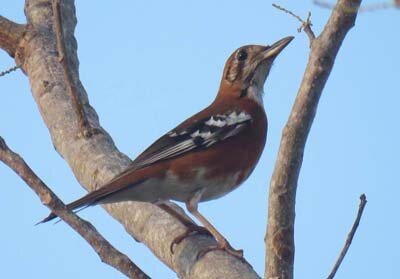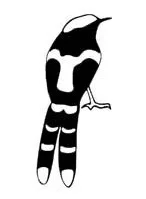
Little-known Oriental bird - Red-faced Malkoha: 2 Juveniles are shorter-tailed than adults, show a much reduced brick-red face patch and a browner bill. The crown, nape and breast have a brownish ground colour, with off-white flecks in the crown, nape and chin. Although the mantle is black with blue and green iridescence, the remiges and rectrices are browner, and have more pointed tips (R. F., pers. obs. BMNH). A variety of call notes has been described, but this species is generally considered rather silent. Legge (13) compares a low monosyllabic 'kaa' uttered in flight and on alighting with one of the notes of 'our jay at home' (Garrulus glandarius ?). He also talks of a much harsher and louder cry which contra Hoffmann (10) is not inconsistent with Biddulphs description of the call he heard from a perched bird in India, although Legge does not refer to this call in a later work. (14) A low petulant 'kra', a soft 'krrr' compared with the purring of a cat, 'kree-kree-kree', a 'kok' and short yelping whistles are also described. Breeding Dated records and gonadal examinations indicate that Red-faced Malkohas breed at least from January to May and probably again in the autumn, and Ali & Ripley (2) suggest that breeding may be continuous. More dated records of breeding evidence are required. The nest is usually described as a shallow saucer of grass, roots and twigs 'carelessly' put together, although what appears untidy to the human observer should probably not be anthropomorphised as careless; indeed, an untidy nest is probably better camouflaged. In May 1978, Shirley Perera observed a breeding attempt on the banks of the Walawe River in the Uda-Walawe National Park. The well-anchored and well-concealed nest was in the topmost fork of a Kunumella tree Diospyros malabarica about 9-12 m from the ground. The stout platform was formed of interlocking branching twigs 15-20 cm long; over this was placed a thick layer of twigs, presumably imparting the untidy appearance, and over this a layer of Kunumella leaves. The cup was deep and neatly lined with leaf midribs, although Baker (3) indicates that the nest is shallow and lined with fresh leaves. Both sexes participated in nest building, and during a period of about a week, the male was observed following the female uttering a soft 'kree-kree-kree'. Unfortunately this nest was abandoned owing to disturbance from a pair of Greater Racket-tailed Drongos, Dicrurus paradiseus, nesting nearby (Perera, in litt.). A nest found in the Sinharaja forest in February 1995 was in dense foliage in the lower canopy of a tree ca. 18 m high. One bird was incubating. The clutch consists of two or three rounded oval eggs, measuring about 36 x 27 mm and unmarked white with a chalky surface. There are no details of subsequent stages of breeding, although a pair 'soon returned' to their nest after being flushed (3). Diet and Habits This species feeds mainly on berries of forest trees, but insects are also taken (perhaps when feeding young?). One has been observed eating a large caterpillar about 5 cm long, and another taking the caterpillars of a common moth pest of teak (Ceylon Bird Club Notes). It usually feeds in mixed-species foraging groups where one to four birds is the norm. Larger flocks occur occasionally, the largest reported group is of nine birds. The Red-faced Malkoha is described as a rather silent, shy, restless and sprightly dweller of tall forest canopy. Fleming (7) describes this bird as agile, active and conspicuous, although wary of observers and indicates that it is active mainly in the morning and afternoon. Henry (8) presents a vivid picture of its locomotion, 'It cleverly threads its way through tangled twigs, creepers and foliage. Owing to the short, rounded wings, its flight is feeble, slow and direct and, if it has any distance to cover, it commonly prefers to hop from branch to branch until it reaches the top of a tree, and then to flutter and volplane from that vantage-point; in flight, the wings produce a musical hum.' Legge (13) notes that a female, 'on alighting each time, uttered its low call and elevated its tail', and that a pair 'flew with short flights from tree to tree, one after the other.' Status and Frequency The Red-faced Malkoha is currently listed as Vulnerable (5). It faces a high risk of extinction in the medium-term future through habitat decline and fragmentation, and will show an estimated continuing decline of at least 10% within 10 years (12). Since 1873, the Red-faced Malkoha has been considered everything from 'extremely rare' to 'quite common' in no obvious chronological order, although care must be taken when describing the status of a localised species, which may be common in some areas but rare as a whole. There can be little doubt that the retiring habits of this largely silent dense forest canopy-dweller result in some under-observation, and this may account for the varying estimates of its abundance; reports that it was common in antiquity are probably exaggerated. Many dire warnings have been sounded (6, 8, 22) and it could be argued that numbers have remained relatively stable since the middle of the present century. However, advances in quality and quantity of field ornithology in Sri Lanka may mean that a growing proportion of a dwindling population is being recorded. Shooting has been cited as contributory to the apparent decline at least in the dry zone. (9) Reports indicate that the flesh is tender and not unpleasantly flavoured, (8) but hunting is unlikely to be a widespread contemporary problem (Wijesinghe in litt.). The Red-faced Malkoha is undoubtedly local, owing to fragmentation of its forest habitat; it is not uncommon in some restricted areas (9) and enforced protection of key forest reserves, e.g. Sinharaja and surroundings is generally considered essential to its continued survival. It is important to note that some ornithologists do not consider this species to be under particular actual threat (e.g. Perera in litt.), providing the integrity of current forest reserves is maintained. However, this is a rather large proviso. Under the Flora and Fauna Protection Ordinance, many National Parks and Sanctuaries have been declared, but development continues unchecked in many areas and laws are rarely enforced. Unless a coordinated strategy is adopted, continuing fragmentation of forest reserves may result in the extinction of this, and several other Sri Lankan endemics. Hoffmann (10) has cited the presence of various international conservation organisations in Colombo as exacerbating this problem, each of them not wanting to bite the hand that feeds, and it is perhaps time for these organisations to critically review their role in the process of conservation in Sri Lanka. Very little of the Red-faced Malkohas life history has been recorded, particularly its breeding biology, biometrics and moult strategies. Its geographical and altitudinal distributions remain controversial, population densities and dynamics, detailed niche requirements and threats to survival other than deforestation are all unknown. As far as its conservation is concerned, there is an urgent need for further study of the Red-faced Malkoha, to paint a rational picture of the status of this enigmatic species. Too many dire warnings can result in desensitisation of the public and the government, and it is imperative that such warnings are based on firm empirical study to ensure that what little political will there is can be harnessed to the greatest effect. At this stage, it seems safe to say that further fragmentation of forest habitat will certainly result in further decline of this beautiful cuckoo. The authors are currently working on a monograph of the cuckoos and turacos. Acknowledgments We would like to thank Thilo Hoffmann, Deepal Warakagoda, Shirley Perera, Gehan de Silva and Priyantha Wijesinghe for providing valuable information during the preparation of this article. We are also very grateful to Thilo Hoffmann for helpful comments on a draft of this paper. References - Ali, S. (1969) Birds of Kerala. Oxford University Press.
- Ali, S. and Ripley, S. D. (1983) Handbook of the birds of India and Pakistan (Compact Edition). Oxford University Press, Delhi.
- Baker, E. C. Stuart (1934) Nidification of birds of the Indian Empire. Vol III, Taylor & Francis, London.
- Biddulph, C. H. (1956) Occurrence of the Red-faced Malkoha, Phoenicophaus pyrrhocephalus (Pennant) in Madura district, Madras presidency. J. Bombay Nat. Hist. 53: 697-698.
- Collar, N. J., Crosby, M. J. and Stattersfield, A. J. (1994) Birds to watch 2. BirdLife International, Cambridge.
- Fisher, J., Simon, N. and Vincent, J. (1969) The red book, wildlife in danger. Collins, London.
- Fleming, R. L. (1977) Comments on the endemic birds of Sri Lanka. Ceylon Bird Club, Colombo.
- Henry, G. M. (1955) A guide to the birds of Ceylon. Oxford University Press, London.
- Hoffmann, T. W. (1984) National red data list of endangered and rare birds of Sri Lanka. Ceylon Bird Club and Wild Life and Nature Protection Society of Sri Lanka, Colombo.
- Hoffmann, T. W. (1996) New bird records in Sri Lanka and some connected matters. J. Bombay Nat. Hist. 93: 382-388.
- Hoffmann, T. W. (1997) Red-faced Malkohas. Newsletter for Birdwatchers 37(1): 14-15.
- IUCN (1994) The Red List (Electronic version). Gland, Switzerland.
- Legge, W. V. (1873) On Phoenicophaus pyrrhocephalus Forster. Stray Feathers 1(5): 346-348.
- Legge, W. V. (1878-80) A History of the Birds of Ceylon. London.
- Nanda, B. C. (1996) A crake and a malkoha. Newsletter for Birdwatchers 36(5): 95.
- Newton, A. (1879) Letters to the editor. Stray Feathers 8: 414-415.
- Peters, J. L. (1940) Checklist of birds of the World. Harvard University Press, Cambridge, Massachusetts.
- Sibley, C. and Monroe, B. (1990) Distribution and Taxonomy of Birds of the World. Yale Press.
- Tirimanna, V. (1981) The Red-faced Malkoha. Loris 15(6): 310-312.
- Wait, W. E. (1931) Manual of the birds of Ceylon. 2nd Ed.
- Wijesinghe, D. P. (1996). The history of ornithology in Sri Lanka. Bull. OBC 27
- Wikramanayake, E. B. (1969) Some rare and vanishing birds of Ceylon. Loris 11: 374-376.
|