Restoring conservation forests in northern Thailand and the monitoring of frugivorous birds: 2 The Framework Species Method developed by Nigel Tucker and his colleagues in Queensland, Australia in the late 1980s (4-6) is a practical method for accelerating forest regeneration. Native tree species that can rapidly shade out weeds and are attractive to seed-dispersing animals are planted in degraded sites. The sites are enhanced for wildlife, by incorporating rotting logs, nest boxes for birds and other wildlife resources. Once established, the trees provide fruit, nectar or perching sites that attract seed-dispersing birds and mammals from neighbouring forest areas. Planting trees begins the process of biodiversity recovery, with wildlife completing the process. In northern Thailand, the Forest Restoration Research Unit (FORRU) is carrying out research to determine whether a similar approach will work there. Researchers at the unit have developed propagation methods to grow a wide range of native forest tree species in nurseries and test their performance and ability to accelerate the return of biodiversity in experimental plots (7). The role of frugivorous birds Whilst most forest birds probably consume some fruit, 17 families contain species that rely on fruit for a large part of their diet. In a recent comprehensive review of this subject, Corlett (8) reported that the most important of these families in good forest are hornbills, barbets, broadbills, fruit-pigeons, muscapids, bulbuls, white-eyes, laughingthrushes, babblers and flowerpeckers. However, in degraded forest, or the restoration plots being established by FORRU, many of these frugivorous species are absent. Indeed, many species, such as hornbills and fruit-pigeons are unlikely to venture into degraded areas newly planted with young trees. Furthermore, since most large frugivores have become extirpated, we have to look towards other, smaller fruit-eating species, tolerant of degraded areas to disperse seed. These primarily include bulbuls and mynahs, but also jays and magpies; thrushes, robins and chats; white-eyes; laughingthrushes and flowerpeckers. Surprisingly, many of these are insectivores which also take fruit. Replanted areas where the canopy has closed that are situated close to good forest might support green pigeons, Oriental Pied Hornbill Anthracoceros albirostris and possibly wood pigeons. |
|
Oriental
Pied Hornbill,
(Christian Artuso) |
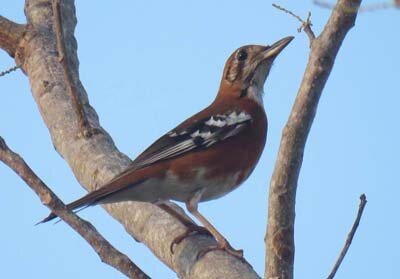
Role of bird watchers Restoration of natural forest ecosystems for wildlife conservation is becoming a very important component of the biodiversity conservation agenda. Recently, an international meeting was held in Chiang Mai, Thailand to draft a research agenda for the restoration of tropical forests for wildlife conservation in South-East Asia. Two of the areas identified as requiring urgent attention were seed-dispersal and plantation design. One question that immediately springs to mind is which tree species can attract frugivorous birds from forest into degraded areas? This can be studied by noting the species and numbers of birds visiting fruiting trees in good forest. Indeed, FORRU has carried out initial studies in this area; one such study funded by an OBC conservation grant. However, a small research unit such as FORRU does not have the staff or resources to carry out extensive studies. Can you help? On a recent visit to Doi Inthanon, early on a February morning, interesting birds eating fruit in trees included migrant thrushes such as Grey-sided Thrush Turdus feae and Eye-browed Thrush Turdus obscurus, Purple Cochoa Cochoa purpurea and Yellow-bellied Flowerpecker Dicaeum chrysorrheum along with Wedge-tailed Green Pigeons Treron sphenura and several bulbul species. Information on species and numbers of birds and a description of the tree (preferably with a photo), or better still a dried specimen of the leaves and fruits, would be very useful for FORRUs research programme. Observations of birds consuming fruits are made all the time by birders in the region, who may not appreciate their value. Records of birds visiting severely degraded forests or restoration plots (not necessarily to consume fruits) would also be very valuable. Why? Because we need to plant tree species that attract seed-dispersing birds into degraded areas. References
- Bhumibamon, S., 1986. The environmental and socio-economic aspects
of tropical deforestation: a case study of Thailand. Department
of Silviculture, Faculty of Forestry, Kasetsart University. 102
pp.
- FAO, 1997. State of the World's Forests 1997.
- Leungaramsri, P. and Rajesh, N., 1992. The Future of People
and Forests in Thailand After The Logging Ban. Project For Ecological
Recovery, Bangkok, Thailand. 202 pp.
- Goosem, S. and Tucker, N., 1995. Repairing the Rainforest. Cassowary
Publications, Cairns, Australia.
- Tucker, N. and Murphy, T., 1997. The effects of ecological rehabilitation
on vegetation recruitment: some observations from the Wet Tropics
of North Queensland. Forest Ecology and Management 99: 133-152.
- Lamb. D., Parrotta, J., Keenan R. and Tucker, N., 1997. Rejoining
habitat fragments: restoring degraded forest lands. pp. 366-385
in Laurance, W. F. and Bierregaard, R.O. (eds), Tropical Forest
Remnants: Ecology, Management and Conservation of 7 Forest Restoration
Research Unit, 1998.
- Forests for the future: growing and planting native trees for
restoring forest ecosystems. Biology Department, Science Faculty,
Chiang Mai University, Thailand.
- Corlett, R. T., 1998. Frugivory and seed dispersal by vertebrates
in the Oriental (Indomalayan) Region. Biol. Rev. 73: 413-448.
Fragmented Communities.
|