An expedition to Damar Island, South West Maluku, Indonesia:
2
The Damar Flycatcher has been observed repeatedly along the
forest edge in an area targeted for further conversion to garden
plots (usually an area 50 m by 70 m is cleared). Spending time
at forest edge scanning the rattan understorey and potential
perches below 3 m is a good place to begin a search for this
species. Damar Flycatcher is widespread here, and learning its
sibilant whistle will greatly assist detection. Male birds are
far easier to observe, females often present with males but skulking
within dense rattan. There are no well-marked forest trails so
it is necessary to follow hunter-guides who know the forest.
Olive-headed Lorikeet Trichoglossus euteles (Nuri hijau) will
be heard frequently flying rapidly over the canopy, the less
common Blue-streaked Lory (Asturi, Nuri biru or Nur Mer-mer)
occasionally so. While the canopy is full of forest pigeons,
the understorey and subcanopy often seem empty of birds other
than the ubiquitous Spectacled Monarch. However Golden Whistlers,
White-bellied Whistlers, particularly the females, are often
seen skulking low in bushes or even hopping along the forest
floor. Orange-sided Thrush can be observed daily, but getting
a view of Elegant Pitta Pitta elegans amongst the dense understorey
will prove more difficult. Similarly, the Metallic Pigeon Columba
vitiensis was recorded here several times but is not confiding.
|
|
Damar
Flycatcher, male
(Colin Trainor) |
Kumur area (Kwai Protection Forest)
The easiest place to observe Damar Flycatcher during the 2001
survey was the lush semi-evergreen forest south of Kumur, but actually
owned by Kwai village. Kumur is an interesting 3 h (7 km) walk
from Wulur, but taking a motor boat (1 h) costing c. $US 2 if public
transport or c. $US 10 if a charter, is recommended. Kumur sits
on the western side of the Ayerkota River (the largest on the island)
with the village of Bebar Barat 100 m away on the opposite bank.
The forest is accessed by walking from the village for about 3
km (1 h), much of this along the scenic Ayerkota valley. Habitat
along the valley includes some secondary forest, relatively extensive
dense canegrass along the river, and coconut and clove plantations.
It appears to have potential for rails, warblers and waterbirds,
although apart from Pacific Reef Egret none were observed during
recent work. Good views can be obtained of forest on steep slopes
along the length of the valley with Brahminy Kites and flocks of
frigatebirds Fregata spp soaring above. Blue-tailed Imperial Pigeons
glide down from the ridges and Olive-headed Lorikeet is very common
in flowering coconuts. Birds are under lower hunting pressure here
than Wulur (where there are many air rifles) with the Orange-footed
Scrubfowl Megapodius reinwardt (Hibla manu) calling frequently
from mangroves close to Kumur village.
Another garden lodge is a useful base for walks to the adjacent
forest where Orange-sided Thrush, Emerald Dove, Rufous-sided Gerygone,
Dollarbird Eurystomus orientalis (Manu metan) and Green-cheeked
Bronze Cuckoo are frequently observed. After entering forest Damar
Flycatcher is often seen while walking along the well-marked forest
trails, usually perched on lianas or saplings 12 m above ground,
where they sit silently scanning the ground below and any bare
surfaces for insects. When a prey item is observed they wing-flap
in apparent excitement, then fly to ground and forage amongst litter,
or glean insects from shrubs or tree trunks. Their weak whistled
call can be widely heard throughout the forest. The Blue-streaked
Lory (Kasturi) may be observed feeding on the flowers of the Salawaku
tree or Jambu air (Syzygium sp), but more usually flying at speed
over the canopy. Cinnamon-collared Kingfisher and Elegant Pitta
may occasionally be seen. Barn Owl Tyto alba (Uru) screech at night
from the garden camp where they hunt the abundant rats, Rattus
argentiventer. After finishing with forest observations, more working
of the modified habitats along the Ayerkota River valley is a likely
area to add new species for the island.
Batumerah
Forest at Batumerah is best accessed by travelling in dugout
canoes 3 km along the coast from the village to the mouth of the
Awehnyo River, then following the river inland for about 1 km until
primary forest is reached. Man-modified coastal habitats here include
mangroves, beach forest, coconut plantation and riparian forest.
The Barred-necked Cuckoo Dove Macropygia magna was recently recorded
for the first time on Damar from degraded forest near the river
mouth, however this habitat contains few other birds of special
interest except for White-bellied Whistler, which is common, while
Osprey Pandion haliaetus fish along the coast. Working from a base
hut in a garden plot is a good way to explore the tall semi-evergreen
forest along the river. In 2001 a male and female Damar Flycatcher
were observed for several hours as they moved through the camp
garden foraging for insects. They regularly perched on large logs
and the garden fence and flew down to the ground to feed amongst
litter, on bare rocks and in chilli bushes. They typically spent
12 h in the gardens each morning working an area of 0.2 ha, and
then moved back into the surrounding forest. Glossy Swiftlet Collocalia
esculenta is a common aerial species in forest gaps and over gardens.
The Rainbow Bee-eater Merops ornatus was newly recorded for Damar
from this habitat.
Specialities in the Batumerah forest include Cinnamon-collared
Kingfisher (likely to be observed perched above the river), Orange-sided
Thrush, Elegant Pitta, Metallic Pigeon (they drink from the river
in early morning), Black-banded Fruit Dove, Orange-footed Scrubfowl
and perhaps Barred-necked Cuckoo Dove. Only a single individual
of the latter was recorded in 2001, but it is likely to have been
under-recorded. There are no marked forest trails but walking along
the rocky river channel, or with a local hunter who knows the area
is a good way to explore. Unfortunately, there is active forest
conversion to agricultural plots, with several being created further
upstream during the survey.
Terbang Utara and Terbang Selatan
Two islets (56 km2 each) located about 10 km and 15 km south
of Damar are of avifaunal interest they were birded for the first
time in Sep 2001. Access is available through chartering a small
motorboat from Wulur (c. $US 70100 for 23 days). It would be possible
to visit both islands in one day. Both are covered in intact tropical
dry forest (1025 m high) and coastal shrub, with extensive beaches,
rocky shoreline and coral reefs. A total of 34 species was recorded
on these islands, five unrecorded from the Damar mainland; migrating
Ruddy Turnstone Arenaria interpres and Pacific Golden Plover Pluvialis
fulva, Beach Thick-knee Esacus neglectus, Little Pied Cormorant
Phalacrocorax melanoleucos and an unconfirmed species of cuckoo
(probably Pied Bronze Cuckoo Chrysococcyx crassirostris).
Green Turtle Chelonia mydas nest on the beaches at night and the
nocturnal calls of the Turtle Bird (Urur Penu) or Beach Thick-knee
are a sign for local people that turtles are nesting. Beach Thick-knee
is common on both islands (perhaps 1030 individuals on each). It
can be observed throughout the day foraging on beaches and exposed
rock platforms, feeding on barnacles and molluscs. There is a roosting
colony of Greater Frigatebird Fregata minor and Lesser Frigatebird
F. ariel on Terbang Selatan said to sometimes number in the 1000s
(about 100 individuals in 2001). In addition, the abundance of
several species is much greater here than on Damar. The Orange-footed
Scrubfowl is exceptionally abundant (35 pairs observed per hour),
as are Pink-headed Imperial Pigeon, Black-banded Fruit Dove and
Rose-crowned Fruit Dove, whereas White-tufted Honeyeater was surprisingly
rare.
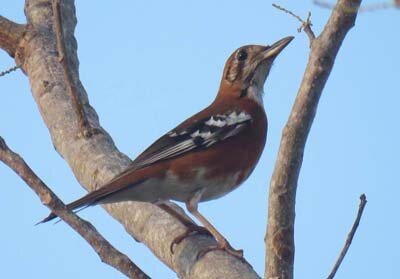
|
|
Orange-banded
Thrush
(Colin Trainor) |
Conservation
Damar Island lies in a global biological hotspot, the Banda Sea
Islands Endemic Bird Area (EBA 165: Stattersfield et al. 1998).
This EBA harbours 18 endemic and 41 restricted-range bird species.
Damar, supporting more restricted-range birds than Sumba (an island
more than 50 times larger) is of high conservation interest with
its single endemic Damar Flycatcher, near threatened Blue-streaked
Lory and other globally restricted forest birds such as Orange-sided
Thrush and Cinnamon-collared Kingfisher, demanding the greatest
attention (see Table 1). With 70-80% (140-160 km2) of the island
still covered in semi-evergreen and dry tropical forest there appears
little threat to these species in the near future. However, small-scale
logging carried out by local people, and increasing forest clearance
for crops to feed a slowly rising human population will continue
to place low-level pressure on the forest. As on the Sangihe and
Talaud Islands (after Wardill and Riley 1999) showing that birds
and forest are important in their right by visiting the island
and paying local guides is one way that the Damarese can see tangible
benefits of their forest stewardship. Understandably they find
it difficult to believe why anyone would travel thousands of kilometres
to see birds on their island.
Three restricted-range species went unrecorded during the survey;
Kai Cicadabird Coracina dispar, Black-bibbed Monarch Monarcha mundus
and Tricolored Parrotfinch Erythrura tricolor. Any new information
to assist our understanding of the status of these and other interesting
species such as the newly reported Barred-necked Cuckoo Dove and
Shining Starling Aplonis metallica would be useful. Research priorities
for the Damar Flycatcher include a census to assess its population
size and distribution, although it is now considered common and
widespread in forest and under little threat of extinction.
Bibliography
- Hartert, E. (1900) The birds of Dammer Island in the Banda
sea. Novit Zool. 7:1224.
- Stattersfield, A. J., Crosby, M. J., Long, A. J, and Wege,
D. C. (1998) Endemic Bird Areas of the World: priorities for
biodiversity conservation. BirdLife Conservation Series No. 7.
Cambridge, U.K.: BirdLife International.
- Trainor, C. (2001 in prep) The status of forest birds on Damar
Island, Lesser Sundas, Indonesia. Prepared for Forktail.
|